There are people in your organisation who are doing exactly what you need them to do, and they are doing it in a way that gives you no reason to question it.
They deliver, they take responsibility, and they hold things together when it matters. You don’t need to chase them, and you don’t need to double check their work. If anything, they’re the people you rely on when something needs to be carried without any noise around it, so naturally they get trusted and given more.
That’s usually how it builds.
What doesn’t get seen is what it’s taking for them to keep operating like that, and the reason it gets missed is because there isn’t a clear moment where it demands attention. Nothing breaks, nothing drops, and there’s no obvious signal that something needs to be addressed.
I spend a lot of time working with these individuals, and they don’t come into coaching because something has gone wrong. There’s no incident or performance issue to point to. They come because something about how they’re operating has started to feel heavier than it should, although they don’t always describe it that way.
They’ll talk about wanting to be sharper, or more focused, or less in their head, and they tend to frame it as something they should be able to improve if they just approach things differently. On the surface, it sounds like a performance conversation.
It rarely is.
When you stay with it, what becomes clear is not that they’re doing less, but that they’re doing far more than is visible in order to sustain how they’re seen.
They’re thinking ahead of conversations before they happen, adjusting how they speak depending on who’s in the room, holding back until they’re certain something will be received in the right way, and going back over decisions after they’ve been made even when nothing has actually gone wrong. That level of internal management becomes part of how they operate.
From the outside, none of that shows up. What you see is someone who is composed, consistent, and in control, which is exactly why it’s so easy to miss.
Upwards, they’re often very effective. They understand what matters, how to present it, and how to stay aligned, and they don’t tend to create friction in places where it would be noticed. That shapes how they’re trusted and how they progress.
Across their team, the experience can feel different, although not in a way that is immediately obvious or easy to challenge. Standards are high, but they’re not always clear, and expectations can shift depending on pressure. When something isn’t quite where it needs to be, the response is contained, but it’s enough to change how people operate around them.
People become more careful. They check things more. They hold work back until they’re confident it won’t be picked apart, and even then it often gets refined further before it’s shared. The quality of output improves, but people start to pull back rather than step forward.
This isn’t about whether the individual is capable of doing the role. They are, and in many cases they’re doing it well. The question is what it’s costing them to keep doing it this way, and what becomes less available as a result.
Over time, there’s a shift in how they operate. They rely less on their own instinct and more on how something will be received. What they think is filtered before it’s expressed, shaped in advance, and adjusted to fit the situation they’re in. The more direct, grounded version of them doesn’t disappear, but it becomes less accessible.
In its place is a version that works, in the sense that it meets expectation and maintains control, and because it works, it gets reinforced.
The difficulty is that it narrows what they have access to. They’re still performing, but they’re not thinking as freely, challenging in the same way, or taking the same level of risk in how they show up. A portion of their capacity is tied up in managing how they’re perceived rather than being available for how they think and lead.
That doesn’t show up immediately. It builds over time, and it doesn’t stay contained within the role.
The effort required to sustain that level of control doesn’t switch off when the working day ends. It follows them into the rest of their life, into how present they are with the people around them, and into how much mental space they actually have when nothing is being asked of them. They’re there, but part of their attention is still tied up in what’s unfinished or what needs tightening.
It isn’t one moment that creates that shift. It’s the accumulation of it.
Organisations will often respond to this by talking about authenticity, and positioning it as something that’s encouraged within the culture. What tends to happen in practice is something more controlled than that.
People become very good at presenting a version of themselves that appears open, while still carefully managing how they’re perceived. They know what can be said and what can’t, how to come across as real without creating risk, and how to stay within the boundaries of what’s acceptable.
It looks like authenticity, but the underlying effort doesn’t change.
People don’t usually reach a point where they can’t do the role. They reach a point where continuing to do it like this becomes too much.
Some leave when that becomes clear. Others stay and continue to perform, but never quite access what they’re capable of when they’re not operating through that level of control.
Nothing about that is easy to measure, which is why it’s so often missed.
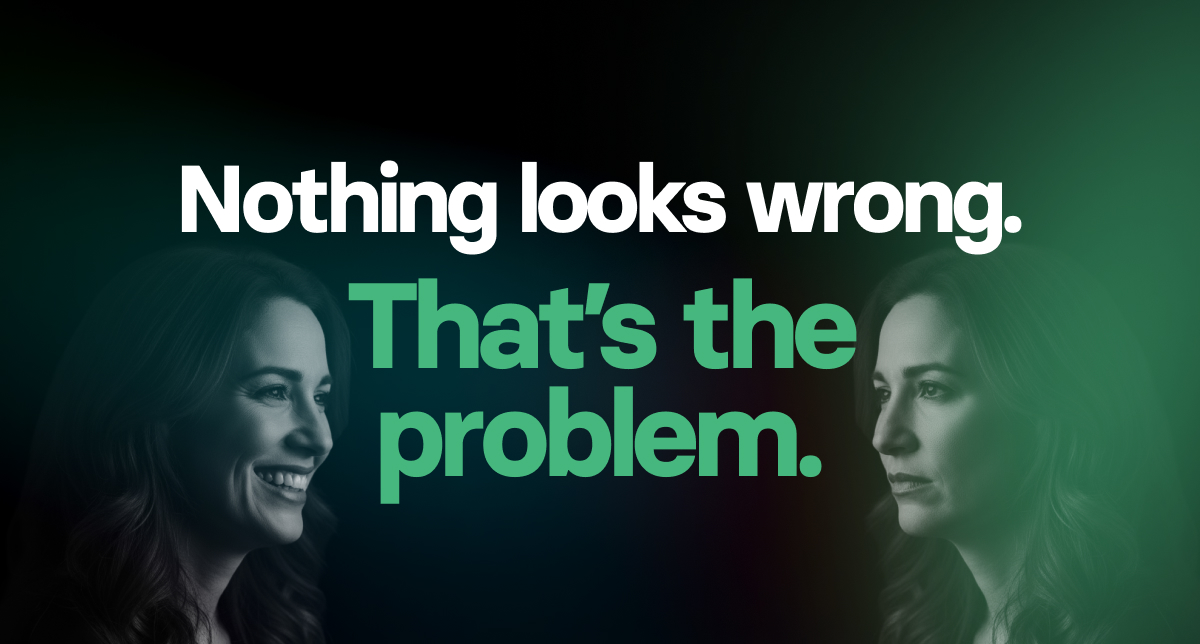
Nothing looks wrong.
That’s the problem.
⸻
If This Feels Familiar…
This isn’t something that shifts through another survey or a one-off intervention.
It requires a proper look at how people are operating beneath the surface, and what it’s taking for them to sustain performance.
If you want to explore this properly, start here;
Watch the full breakdown of The Silent Middle 👇
If it resonates, it’s worth a conversation. Email us at: engage@paseda360.com