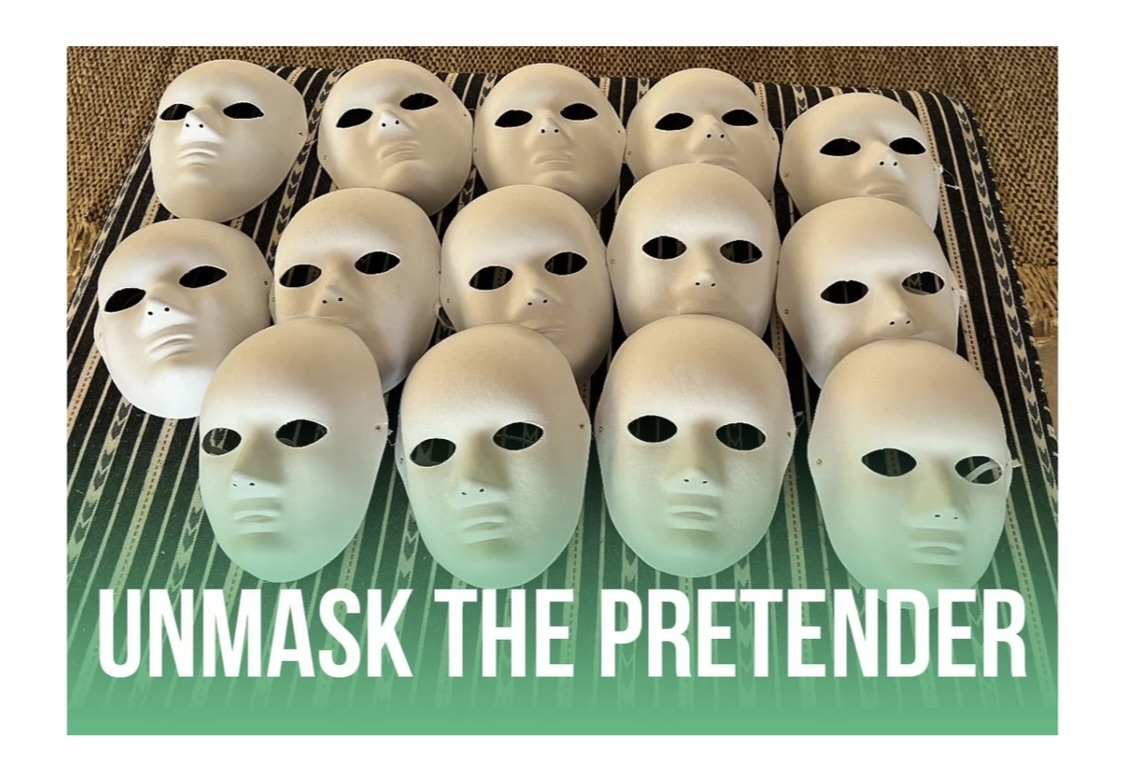
Most coaches are remarkably self-aware when it comes to their clients. They listen for the story beneath the story, they track the nervous system, they hold the silence (or, in our case, the not silence), and they pride themselves on their ability to tune in with precision. Yet, ironically, it is in this same seat of apparent awareness that something far less spoken about operates quietly in the background, influencing the coaching relationship with a force that is both subtle and profound. That thing is the Pretender Mask.
When I teach the Paseda360 Pretender Model, people almost always assume I am referring to something that the client does, a pattern the client brings, a protection the client learned, something the client must unpick. But the uncomfortable, liberating, slightly disarming truth is this: Pretender Masks show up in the coach seat too, and often far more loudly than we are willing to admit. You can train for years, collect certifications, read every book, practise every model, and still find yourself coaching not from your grounded, wise, human core but from an identity you created years ago in order to feel safe.
This is not a moral failing. It is not incompetence. It is the human condition.
The Pretender, in its simplest form, is the identity you built when your nervous system decided that being your whole, unfiltered, unguarded self was not wise. It is the part of you that learned to perform, to adapt, to be acceptable, to be palatable, to be impressive, to be harmless, to be small, to be useful, to be clever, whatever was needed in the environments you grew up in. And because it helped you succeed in adulthood, it feels justified in staying.
Most adults do not even realise they are wearing a Pretender Mask, because the Pretender often looks like competence on the outside even though it feels like pressure on the inside. But in coaching, that pressure has consequences, and not the ones we talk about enough.
At Paseda360, the Pretender Model is made up of four core roles: The Perfectionist, The People Pleaser, The Persecutor of Self and The Persecutor of Others. These are not personality traits or moral categories. They are survival strategies your nervous system learned long before you ever held a notepad in a coaching session. They are the patterns you fall into when your emotional equilibrium is threatened, especially in moments where you feel exposed, evaluated, stretched or uncertain.
And if you think coaching does not bring up those feelings, you have not been in the coaching seat long enough.
The coaching room is an activator. It tests identity. It stirs old stories. It puts the spotlight on your competence, your intuition, your emotional capacity, your self-worth, and your ability to stay with another human in their mess without letting your own history interfere. Which means that, even with the best intentions, your Pretender can step in front of you and run the session before you have even realised it has entered the room.
So let us be honest about how each mask shows up in coaches, because this is where the real shift begins.
The Perfectionist Coach
The Perfectionist Coach is the one who believes they must get it right, though right is never clearly defined and always impossible to reach. They arrive early, over-prepared, slightly tense. They scribble notes because the silence feels unsafe without proof of doing. Their body is stiff, their smile a little too managed, their breathing too shallow. They want so much to be seen as competent that they miss the actual relationship unfolding in front of them.
Inside, the inner critic hums at full volume. You should have asked that differently. You do not sound like a proper coach. They are going to realise you have no idea what you are doing. The Pretender whispers these lines not because it hates you, but because it is terrified that your worth is conditional on flawless performance. And rather than grounding, the coach contracts. They become more technique than presence.
It is exhausting for them. It is suffocating for the client. And it is completely reversible once the mask is recognised for what it is, a pattern rather than an identity.
The People Pleaser Coach
The People Pleaser Coach means well. Their intention is kindness, protection, harmony, connection. But internally, something far more primal is operating, a fear that telling the truth will rupture the relationship. So they rescue clients from discomfort, soften edges, dilute reflections, smile too often, agree too much and subtly avoid the places that would make the session transformative.
They leave the room tired, uncertain and deflated, replaying the session with questions like, Did I push too much. Did I say too little. Did I upset them. Did they like me. When People Pleasing runs the session, the client may feel momentarily soothed but rarely empowered. What looks like gentleness is often self-protection in disguise.
Again, this is not failure. It is fear of disapproval. And when a coach sees it, acknowledges it and learns to regulate through it, everything changes for them and for their client.
The Persecutor of Self
This mask creates some of the most tender, most anxious, most quietly suffering coaches. They work hard. They care deeply. They want to make a difference. But the narrative that runs through their internal world tells them they are not enough. So even after a powerful session, and often precisely after a powerful session, they walk out convinced they did something wrong.
They overanalyse. They dissect every sentence, every pause, every moment where they felt uncertain. Their nervous system equates uncertainty with inadequacy, so they shrink internally even while the client feels expanded. And the tragedy is that the coach does not get to feel the impact they actually made.
Left unaddressed, this creates burnout. Seen clearly, it creates liberation.
The Persecutor of Others
This one is harder to admit, but every coach has felt it. The client is not engaging properly. They are not reflective enough, open enough, willing enough, brave enough. The coach feels frustration, a subtle, quiet irritation masked by professional politeness. Underneath that frustration sits fear. Fear of being ineffective. Fear of being irrelevant. Fear of being exposed, inexperienced or inadequate.
When this mask is activated, coaching shifts from curiosity to defence. The coach becomes guarded. The client becomes cautious. The space becomes smaller. And the relationship loses its humanity.
Why This Matters
This is why we teach the Pretender Model before technique in Paseda360. Because you cannot hear a client clearly if your own Pretender is shouting in your ear. You cannot create safety if you are performing. You cannot hold space if you are subconsciously protecting yourself. And you cannot coach at depth until you know which version of you is actually in the room.
The moment coaches understand their own mask, everything shifts.
The pace.
The presence.
The attunement.
The honesty.
The relationship.
The impact.
Coaching is not about looking competent. It is about being relaxed, regulated, real and mask free enough to meet another human without distortion.
So if you are reading this as a coach, I invite you to pause for a moment and reflect.
Which Pretender steps into the room with you.
Which patterns are protecting you.
And what might become possible if you learned to take that mask off, even briefly, so the real you can do the work you were trained and born to do.
Ready to find out more?
Join our next Ask Angela drop in session here